Tuesday, May 26, 2020

copying prototype consists

One of my favorite "sub-hobbies" in model railroading is replicating a particular photo of a real train on the model layout. For me, it's not a planned activity, it's more of an urge that I give in to when the following conditions are present:

(1) someone posts or publishes a photo of a real train in my era (1970's) and location (western WA).
(2) I see the photo (this could be on Facebook or in a magazine such as FOBNR or MRHA).
(3) I realize that I have the same or similar equipment on my layout as in the photo
(4) I don't have a pressing deadline keeping me from acting on the urge to replicate the photo in HO.
(5) the urge to do it is stronger than the discipline to stay focused on building my layout.

These conditions being met, some focused fiddling around with locos and cars and camera(s) can turn into a photo of an HO copy of a prototype locomotive and/or train consist and/or full-on scene. If you work at this hard enough, on a large enough scene, there is even a certificate you can earn in the NMRA's Achievement Program (AP), but that's a story for another time. Today is about yesterday (irony intended).

So, on Sunday 24 May 2020, Brian Elchlepp posted on Facebook three great shots he had taken of a late 1970's BN consist moving southbound through what looks to be Stacy St. yard in Seattle. The consist was unusual - an Alco C-425 on the point, with three back-facing F units. All the conditions listed above were present, and I rushed downstairs to get to work replicating two of these photos.


I didn't get the camera angle quite right, but it sure was fun trying. The hardest part was finding my BN C425 Alco unit. I knew it was somewhere. Eventually, I found it under the layout in a tray, half-way through a decoder installation that I had long forgotten about. This explains why it has no headlight or number boards. However, it is numbered 4258, close enough to the 4260 of the prototype photo. The F units, I didn't pay as much attention to, but it turns out the first F unit in my photo is #826 - a perfect match for the second F unit in the prototype consist. At least I got them all pointed in the correct direction!

I also enjoy trying to match the cars as well as the locomotives, so you can see I took a stab at that. The hardest part about it, on an operating layout like mine, is keeping track of where you grab the specific car from, so you can put it back where it came from after the photo shoot. Those bright yellow Railbox cars are some of my favorites, but they weren't built until 1976, and I supposedly model 1973, so I get a little squishy with time frame sometimes. The most illuminating part is how much more weathered the prototype cars are than the models. When I finish a few more minor track changes on the layout, I'll get back to weathering more of the cars. I've been saying this for at least ten years, and keep discovering more "minor track changes" that I "need" to do.


The sheen and brightness of the model locos is appalling, but this is how we learn. Not to mention the sheen on the backdrop. Interesting! Who knew?

I didn't try replicating Brian's third photo, because I was annoyed that my model didn't (yet) have number boards or rotating beacon (plus, look at the cool rust spot on the side!), but I'm including it here just to celebrate the Alco C-425's that BN ran for its first ten years. Built in the '60's, they had served the SP&S well, and continued to show up here in the Seattle area during the '70's.


Friday, May 22, 2020

stabilizing videos using a hand-held gimbal

I recently purchased an OSMO Mobile 3 hand-held cellphone holder for shooting videos more steadily. The first video I made using it is posted on YouTube here. I'm not sure how it works, but it has battery powered coreless motors that keep the cellphone steady while you are moving around, say, the train layout following a train. It also has software that takes over your cellphone's camera and uses artificial intelligence to lock onto and track moving targets at your command. This can be nice for following specific moving or stationary features as you move around.

The main thing it accomplishes (in addition to giving you another maddening technology-related learning curve to climb up) is to slow you down while you are taking video, so the result is less jerky. I tend to take video like a jack-rabbit: Look at this, oh, now see how it's going over the bridge, oh, look at that grade crossing we need to blow for. As soon as I think of something you might like to see, I shift the camera over in that direction right away. This leads to headaches and dizziness on the part of the viewer. The Gimbal device forces you to shift your viewing angle gradually. I'm finding it to be a learned skill that I can only hope I will acquire with more use.

The reason I got into this was the proliferation of Zoom meetings that are replacing live model railroad gatherings and open houses. The thought was that giving a live layout tour would be better if a gimbal was coming in between me and my cellphone. We will see. If you look at my first effort, on my YouTube channel (linked above), you will find it, frankly, boring. Adding more plot and excitement are my next goals.

One more technical point - the OSMO takes over the cellphone's camera software to allow you to use the cool auto-tracking artificial intelligence features, use a zoom button, etc. But when you log into a Zoom meeting with your cellphone, Zoom also takes over and disables most of what your cellphone camera can do. This means that if you use an OSMO to steady your cellphone while doing a live layout tour in a Zoom meeting, all it will be doing is help steady your hand. None of the other features will work. If you want to use the other features, you have to shoot video clips, and edit them into a movie, and then post that on YouTube or run it on your computer while logged into the Zoom meeting. There also is some debate at these Zoom meetings about how effective it is or is not to show streaming video on your computer to a streaming Zoom audience - it is basically double-streaming. Which may not be that great for resolution or refresh rate. We are all learning as we go, how to share our model railroading hobby with each other during the Covid pandemic.

Sunday, May 3, 2020

giving each track a "purpose"

Running trains is more fun if it seems to "matter" to somebody. And I like to have fun as quickly as possible in between spurts of construction. I recently completed one such spurt of construction on my (4' x 8') N scale layout, increasing the number of spur tracks from 8 to about 20. So here are a few pictures of quick and dirty things I came up with to make it more fun to operate now, while I wait for the time later to build more "meaningful" models and scenery around those new spur tracks.


The piece of cardboard above is simply cut, folded and taped to represent a future model of the Bethlehem Steel (now Nucor) in West Seattle. Instead of three random tracks in a yard, I now have a track for inbound scrap, a second one for outbound product (rebar, in this case), and the outside track for various additives and waste materials from this busy Electric Arc Furnace. (I know, the boxcars should be gons - I'm working with JMRI ops to get that fixed...).

I haven't finished assembling these tank kits I started in the '70's, but hey, stick two tracks next to a couple of tanks and you have a major oil terminal. These loaded tank cars need to be shipped out!


In theory this nice sloped hillside should be covered with trees, but I love the look of the Atlas 40' log bunks so much, and didn't have room for a proper log camp. Then I thought of the term "visible staging", and realized the hillside would work. Sure, it messes with the scenic integrity of the whole layout, but on the other hand, now I have a place for those beautiful log loads to come from. And it looks good nestled next to the trestle like that. Plus, the sawmill that needs the logs (which there also isn't room for)(see the weird-looking building behind the tank farm in the photos prior) is only 2 feet away, so I can easily re-stage the loads after every run.


Who doesn't like to see construction equipment being shipped on heavy-duty flatcars? I'm calling this track "construction contractor" until I come up with a better name, but doesn't it just seem begging for the delivery of another shipment of construction equipment so they can get on with the job? (social distancing requirements notwithstanding...). I'm not sure what all that stuff is, but it looks like it means some serious business. It would be good to put up an office and some chain-link fence, but for now we can definitely switch some cars in there!


This 50 year old engine house is obviously no place for these C44-9W's, but hey, it looks better than having them stand out in the rain! Plus, I also have a weak spot for short coal hoppers, and the smokestack on the engine house is clearly for coal-burning of some kind - for the blacksmith shop if nothing else. Note the effectiveness of parking a few cars next to it, also. The stegosaurus has wandered here from John Allen's layout, and, along with the blacksmith shop, is one of the few remaining coal-consuming dinosaurs left in the global economy.

This track with the station next to it comes out of the "Burlington yard" north of Everett, WA, and becomes the "Concrete Branch" up to the "logging camp" staging track on the hillside I showed a few pictures back. This is also a classic old N scale "freight station" kit, labeled "Adams Heights". If you've ever driven through the real Burlington, WA, on Interstate 5, you've no doubt noticed the house built out on stilts above the freeway. I thought, "why not prop up this station on stilts, and call it an intermediate town on the Concrete Branch, say "Sedro-Woolley", or "Hamilton"? Why not? Then it could receive (or ship) carloads of something and complicate the work of getting those log cars out of staging further up the line. This is an operational no-brainer!

Finally, and what started all this, was the pulp and paper mill in Everett. It will be a while before I build the real model, but in the meantime, how to make it look like it needs to be switched? Here are a couple of things I've done so far:


Pulpwood is needed for making pulp, so here I just parked my inventory of pulpwood loads next to the track, and it looks like a pile of pulpwood all right. I need to find a piece of unloading equipment and this scene will work for years.

I'm not sure which building kit this came from, but doesn't it look like a guard shack with the car parked next to it like that? I know, I need to paint and ballast the track and put road in for the car, but still you get the idea right away. The Micro-Trains tank load in the background works to show that that back track is where all the chemical additives are unloaded for the paper and pulp mill. (The ground throw on the right looks ridiculously out of scale, but that's a subject for another time. Hopefully your eye is more drawn to the guard shack and the auto.)


Finally, here's an overview shot of the paper and pulp mill. I added a short spur in the center to serve as both an engine pocket and a clean-out track. Whenever a switchlist calls for pick-ups or set-outs in the mill, I use the plant switcher to pull or spot from the mill tracks, and have the passing trains use the lead track in front to "interchange" cars with the plant, as you can see is being done here with the CN boxcar. This way the locals don't get bogged down with plant switching work, and the plant switcher can keep things organized.

I'm not sure where the baby on top of the pulp building came from originally. I may have had it since my own childhood. But it occurred to me that Scott Paper Co. in Everett used to have commercials about how soft their toilet paper was, featuring a cute baby, so I placed it there as a reminder about why we need pulp and paper mills, and always will....

Sunday, April 26, 2020

how easy it is to paint backdrops

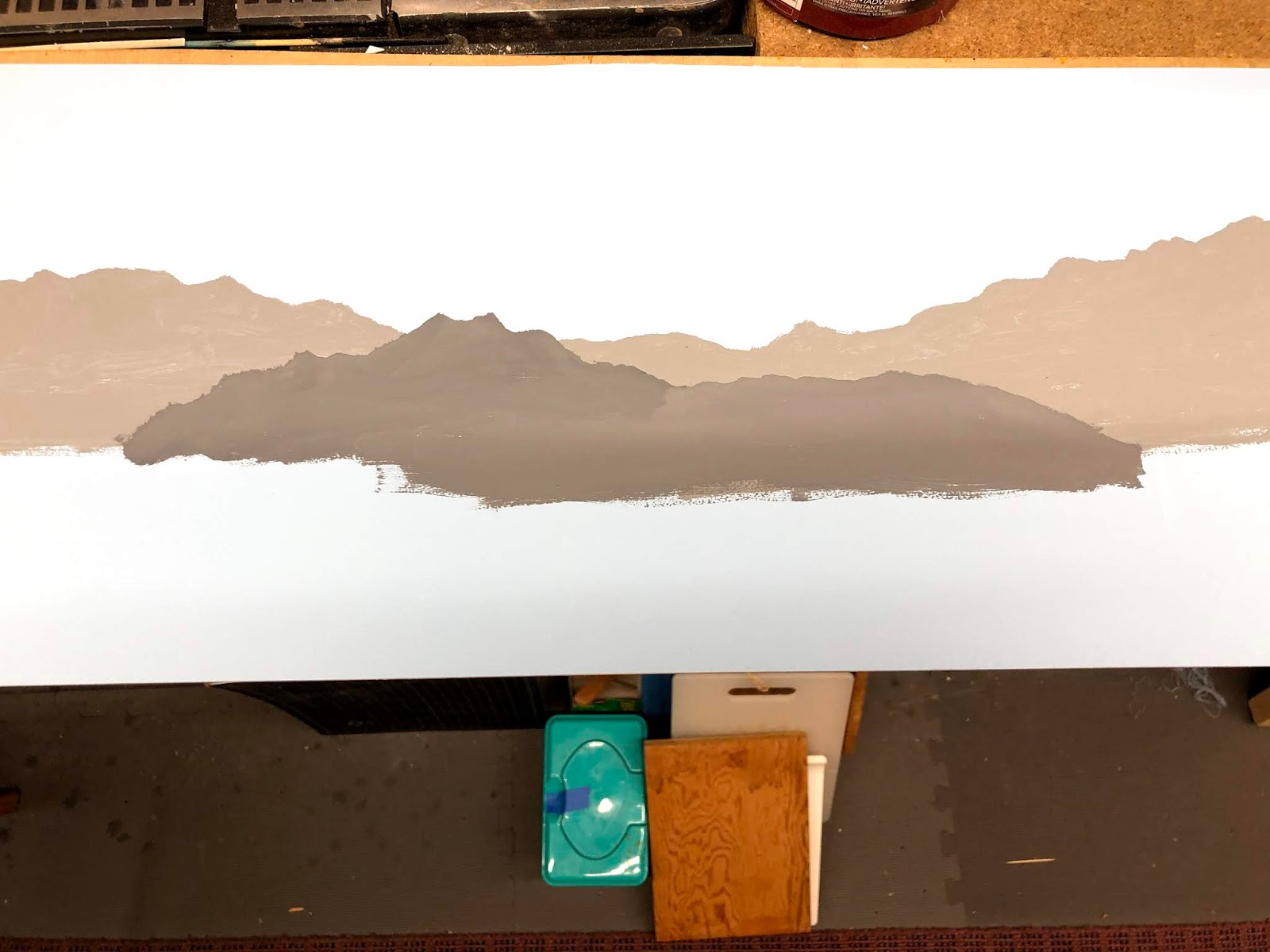
Seriously, it's so scary to contemplate painting a backdrop. But as long as you have a small "fan brush", some grey paint and some green paint, you can have one in just a couple of hours. (That's assuming you have something the right size to paint on - in this case a friend brought me this surplus sheet of 0.1" (2mm) styrene after he was done with his backdrops, which happened to be the right height, so it basically fell in my lap.) Five layers of paint total: Distant mountains (light grey), closer mountains (slightly darker light grey), distant trees (forest green lightened with a little white), and closer trees (forest green). I found that the layers dried enough in about 2 hours that I got the whole 8' piece of 0.1" styrene done in one day of intermittent bursts of painting, while I was doing lots of other things (while also "stuck at home" due to the pandemic, of course). Here's the photographic evidence.

 Above is the whole sheet of styrene laid out on the workbench, with a layer of "distant grey" slapped on there. Below is a section showing the application of "closer grey" applied just in one area, since the whole thing will be mostly covered up by trees.

Now we see the wet second layer of slightly darker green on top of the lighter green. Just a subtle difference in shade is enough to get the effect.


It's absolutely amazing how much this simple thing improves the operation of my simple On30 shelf layout. I wish I had thought of this back when I started building it over a dozen years ago!


It would look even better if I would change out the lighting from the old incandescent Christmas tree bulbs to modern LED strips with a more realistic color temperature. Some day!

Wednesday, April 22, 2020

on putting tracks too close to the edge

Yesterday I was enjoying the fruits of my labor by doing some switching on my N scale layout, when the side of my hand accidentally brushed up against a top-heavy "sky box" car, and it (and several other cars coupled to it) promptly fell off the edge of the layout down on top of the staging yard, derailing a bunch of cars in both trains there. It's not a pretty picture, although at least there was no physical damage to anything.

You can see from the above picture that several cars would have fallen to the floor, had I not recently installed a plexiglass guard at the edge of the staging yard. Now, it is painfully clear that I need another guard at the edge of the upper yard. The next picture shows the gruesome incident from another angle, and a piece of plexiglass on the yard lead already begging to be installed.


Fortunately, I had some leftover strips of 2" wide plexiglass from building the water underneath the HO MILW car barge, so it didn't take too long to measure them, drill holes for the mounting screws (very carefully, using a drill press to minimize the risk of cracking the plexiglass), and install them. I use "fender washers" behind the screws to spread out the pressure on the fragile plexiglass. I don't know what took longer, installing the shields, or getting all those cars back on the track!


The glare from the shields is not ideal, but neither was that derailment in the staging yard. Here's a final picture take from across the other side of the layout, showing that you can barely notice the shield is there, and then only if you're really looking for it.


Friday, April 17, 2020

N scale pulp and paper mills ready for ops

As of today, the tracks are in and operations can begin on the new Everett pulp and paper complex.


Of course there are many decisions yet to make about the structures themselves, pavements, details and so forth, but in the meantime we can start to service these plants with operations and see how it goes. In the second photo, the function of each track is as follows, from left to right:
(1) chemicals in to paper mill (tank cars)
(2) additives (kaolin etc.) in to paper mill (cov. hop.)
(3) paper out (covered track) (boxcars)
(4) paper out (uncovered track) (boxcars)
(5) pulp out (boxcars)
(6) additives for pulp plant (and waste products out?) (cov. hop. & tank & box)
(7) switcher pocket and clean-out track
(8) wood chips unloading (wood chip gons)
(9) pulp wood unloading (gons and bulkhead flats)

The track just below the switcher, and probably the siding below it, will probably be used for staging incoming and outgoing cars for the passing local trains to have someplace to pick up or set out. The switcher will do all the in-plant work. At least that's the plan.

I would to thanks Joe Green, Jerry Green and Mark Dance for inspiring me to add this mill complex to my N scale layout. Their models of such mills are outstanding, and once I saw them in person I had to have one.

Here are a couple more shots of the complex, from different angles:


Saturday, April 11, 2020

N scale steel mill massing study

While we're doing "massing studies" (see previous post on the pulp and paper mill) I took a look at the site for the West Seattle Nucor steel mill on my new five inch wide addition to the N scale layout. I think it's going to work out, although the site is ridiculously condensed for a steel mill model. The back track will be for scrap in (mostly in gons), the middle track will be for the shipping department (mostly gons and bulkhead flats) and the short front track will be for additives in and bag house dust out (mostly covered hoppers and covered gons). All tracks will go into - and be covered by portions of - the building(s).

Here's option 1, from three different perspectives:


It might be a little tall, considering the hill behind it (although that could be fixed by putting a backdrop between it and the hill). Also, this shows the additives and bag house track out in the open, but they probably should be covered.

So, here is option 2, a little longer and less high, from two angles:


I think this second alternative seems better. But it doesn't look complex enough, and we still haven't covered the third track for bag house dust and additives. So, here's alternative 3:


I like it, for now. Although it might make more sense to set up an overhead crane on the left, between the first two tracks, to symbolize the movement of scrap in and product out. Another day we can try looking at that. Let me know your ideas on all this...